
The Science Behind Scent Memory: How Fragrance Creates Lasting Emotional Connections
There’s a particular kind of magic that happens when a familiar scent reaches you unexpectedly. Maybe it's a whiff of sunscreen that transports you instantly to a childhood beach vacation. A trace of your grandmother's perfume in an antique shop that makes your chest ache with tenderness. A bakery smell that conjures a Saturday morning so vividly you can almost hear the voices. In that moment, you aren't just remembering -- you are there, emotionally and viscerally, in a way that no photograph or song could quite replicate.
This is scent memory. And it is perhaps the most profound, most intimate form of memory we possess.
The Anatomy of a Smell
To understand why fragrance holds such extraordinary power over our emotions, we have to start in the nose -- and then travel deep into the brain.
When you inhale a scent, airborne molecules bind to olfactory receptors inside your nasal cavity. Those receptors send signals directly to the olfactory bulb, a structure nestled at the base of your brain. Here is where scent diverges dramatically from every other sense: the olfactory bulb has direct, unmediated connections to two of the most emotionally significant regions of the brain -- the amygdala, which processes emotion, and the hippocampus, which is central to memory formation and retrieval.
Every other sense -- sight, sound, touch, taste -- routes its signals through the thalamus first, a kind of sensory relay station, before reaching these emotional centers. Smell skips that middleman entirely. It arrives at the seat of memory and emotion almost instantaneously, which is why a scent can trigger a feeling before you've even consciously identified what you're smelling.
This anatomical shortcut is ancient. The olfactory system is one of the oldest parts of the human brain, evolutionarily speaking. Our earliest ancestors depended on scent for survival -- detecting predators, identifying food, recognizing kin. Emotion and scent have been intertwined since long before humans developed language. In a very real sense, fragrance speaks to a part of us that predates words.
The Proust Phenomenon: Why Scent Memories Feel So Real
In 1913, the French novelist Marcel Proust described a moment in which the taste and smell of a small cake dipped in tea triggered an overwhelming flood of involuntary memory -- vivid, emotionally rich, utterly unbidden. "An exquisite pleasure had invaded my senses" he wrote, describing how an entire lost world suddenly felt present to him again.
What Proust described so eloquently, neuroscientists have since confirmed: scent memories are uniquely powerful. Research consistently shows that memories triggered by smell are older, more emotionally charged, and rated as more vivid than memories triggered by any other sense. They also tend to be more involuntary -- they arrive unexpectedly, catching us beautifully off guard.
One important reason for this is timing. Most of our strongest scent memories are formed during what researchers call the "critical period" -- roughly from birth through our early twenties. These formative years are when we are building our emotional landscape, forming our deepest attachments, and experiencing everything for the first time. Scents encountered during this period become encoded alongside those powerful emotional imprints, creating associations that can endure for a lifetime.
This is why the smell of a certain cologne might make you feel seventeen again in an instant. Why the scent of autumn leaves carries such inexplicable weight. Why a kitchen smell can make you miss someone you haven't thought of in years.
Fragrance as Emotional Architecture
Our brains are constantly building associative networks -- weaving together sensory input, context, and emotion into memories that define who we are. Fragrance functions as one of the most potent anchors in this architecture.
Psychologists call it associative learning: when a scent is consistently present during emotionally meaningful experiences, the brain links them together. Over time, that scent becomes a kind of key -- one that can unlock the associated memory and its emotional resonance even decades later.
This is not passive or accidental. The scents we wear, the fragrances in our homes, the smells of our workplaces — all of these are quietly embedding themselves into the fabric of our memories and relationships. The perfume someone wears becomes part of who they are to us. Long after they’re gone, a trace of that scent can make them feel present.
For this reason, fragrance has long been used intentionally in therapeutic and ceremonial contexts. Incense in places of worship creates a sensory signal that we are entering sacred space. Aromatherapy uses specific scents to influence mood and calm anxiety. Scent marketing in retail environments is a carefully studied science. Fragrance is not merely decorative. It is communicative -- and it communicates directly to our emotional core.
When Words Fail: Scent Memory and Alzheimer's Disease
Perhaps nowhere is the power of scent memory more movingly demonstrated than in the lives of people living with Alzheimer's disease and other forms of dementia.
Alzheimer's is a progressive disease that systematically dismantles memory and identity. It typically begins with the hippocampus — that crucial center of memory formation — which means that recent memories are often the first to be lost. As the disease advances, it reaches further into the past, erasing names, faces, language, the ability to recognize loved ones. The person you knew recedes, slowly and heartbreakingly, behind a veil you cannot lift.
And yet.
Research has shown that olfactory memory -- scent memory -- tends to be among the most resilient in the presence of dementia. The olfactory bulb and its connections to the amygdala and hippocampus are often relatively preserved longer than other neural pathways. This means that even when a person with late-stage Alzheimer's can no longer speak, no longer recognize their own children, no longer follow a conversation -- they may still respond to a beloved fragrance. Something deep and wordless in the brain
holds on.
Studies have documented patients with advanced dementia showing measurable emotional and physiological responses to familiar scents long after other forms of recognition have vanished. Increased alertness. Facial expressions of pleasure or comfort. Moments of apparent engagement with a world that otherwise seems unreachable.
Scent reaches them when nothing else can.
A Story About Orange Ginger
I want to share something personal — something that happened to me not long ago, and that I will carry with me for the rest of my life.
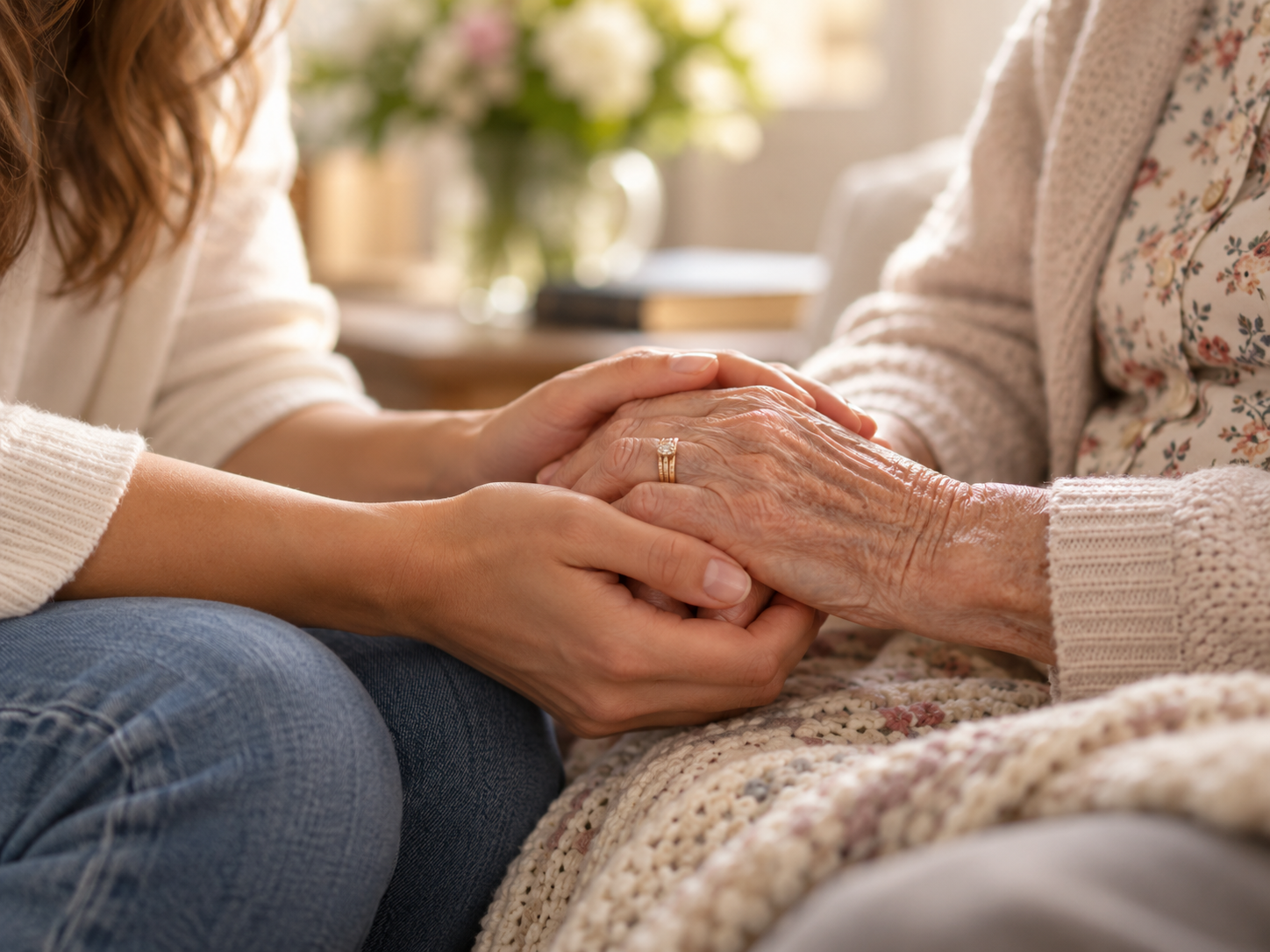
My dear friend was one of those rare people who makes you feel seen and celebrated just by being in the room. She was my cheerleader in the truest sense -- the kind of friend who believed in you fiercely, who remembered what you told her mattered and asked about it later, who showed up. She had been living with Alzheimer's for some time, and in the final stretch of her illness, she had become non-verbal. She no longer knew my name. She may not have known my face.
Her birthday falls in late April, and I went to see her. I brought her a gift: a small Orange Ginger Hand Crème. Orange Ginger was a fragrance she had loved -- a warm, bright, spicy-sweet blend that had been a signature of hers. We had discontinued it for a time, and we had recently brought it back. It felt right to bring it to her.
I told her what I'd brought. I reminded her how much she had always loved this product, this particular scent. She didn't respond. I asked if she'd like to smell it. She shook her head, slowly, no.
So we simply sat together for a while. I talked. She was quiet.
And then, gently, I tried once more. I opened the crème, put a small amount on the back of my hand, and held my hand close to her. I told her what it was. Orange Ginger. The one she used to love.
She leaned forward and smelled it.
Her face changed.
A smile broke across her face -- beautiful and immediate and unmistakable, the kind of smile that comes from somewhere deep, not from politeness or performance but from genuine feeling. She extended her arm toward me. She wanted me to put some on her.
I did. She offered her other arm. I put crème on that one, too, and she smiled the whole time.
I cannot tell you with certainty what she remembered in that moment, or whether "remembered" is even the right word. Perhaps it was not a memory so much as a recognition -- something wordless, something the body knew before the mind could reach it. Something that said: this is good. This is mine. This is warmth.
But I can tell you that in that room, in that moment, something connected. She was there, fully. The light was on. And I was flooded with joy and grief at once -- the particular bittersweet ache of being given back, briefly, someone you have been slowly losing.
The scent of Orange Ginger did what words could not. It found her.
Why We Choose the Fragrances We Love
Our connection to fragrance is not random. The scents we are drawn to reflect our histories, our associations, our emotional landscapes. A person who grew up near the ocean may have a lifelong pull toward marine and salt-air notes. Someone whose grandmother kept a garden may find that roses or lavender carry a comfort that goes beyond the pleasant.
When we find a fragrance that feels like ours, it is often because it resonates with something already inside us -- some association, some emotional memory, some version of ourselves we want to carry forward. In wearing it, we make that feeling portable. We bring it with us.
And over time, the fragrance becomes part of who we are to others. It becomes part of their memory of us. Long after we are no longer with someone, a trace of that scent in the world can make them feel, for a moment, less alone.
The Gift of Fragrance
Understanding the science of scent memory changes how we might think about the fragrances we choose, give, and wear. A perfume or a scented lotion is not merely a pleasant accessory. It is, in a very real sense, an investment in emotional memory -- both our own and that of everyone who loves us.
When we give fragrance as a gift, we are offering something that has the potential to become deeply personal. To weave itself into moments, into relationships, into the ongoing story of a life. Chosen thoughtfully, a fragrance can become a companion -- something that carries comfort in difficult times, that marks celebrations, that anchors us to the people and places we love most.
And if neuroscience has anything to teach us, it's that those connections are not fragile. They are written into the brain in ink that often proves more durable than we might imagine. They persist through time, through distance, through illness, through loss. They can surface when we least expect it and need it most -- arriving, as my friend's smile arrived, from somewhere we thought was beyond reach.
The Invisible Thread
Scent is the invisible thread that runs through the fabric of a life. It connects us to our earliest selves, to the people who have shaped us, to moments we thought we had lost. In a world that’s always moving forward, fragrance has the remarkable capacity to bring the past forward with it -- not as a burden, but as a gift.
My friend is gone now. But somewhere in my memory, she is smiling, holding out her arm in a sunlit room, asking for just a little more.
And when I smell Orange Ginger, she is there.
That is the science of scent memory. And it is one of the most human things I know.